Ratio, Proportion and Variation formulas
At a glance
a : b → a + b parts;  one part = total ÷ (a + b)
a:b and b:c → match b with the LCM;  A/C = (A/B)(B/C)
kA = mB = nC  →  A : B : C = 1/k : 1/m : 1/n
a : b = c : d ⇔ ad = bc;  mean prop. √(ab)
a/b = p/q ⇔ (a + b)/(a − b) = (p + q)/(p − q)
y ∝ x: y/x fixed;  y ∝ 1/x: xy fixed;  part fixed: y = a + bx
a/b = c/d = (a + c)/(b + d)     duplicate a² : b²   sub-duplicate √a : √b
partnership: share ∝ capital × months
A ratio is a count of parts
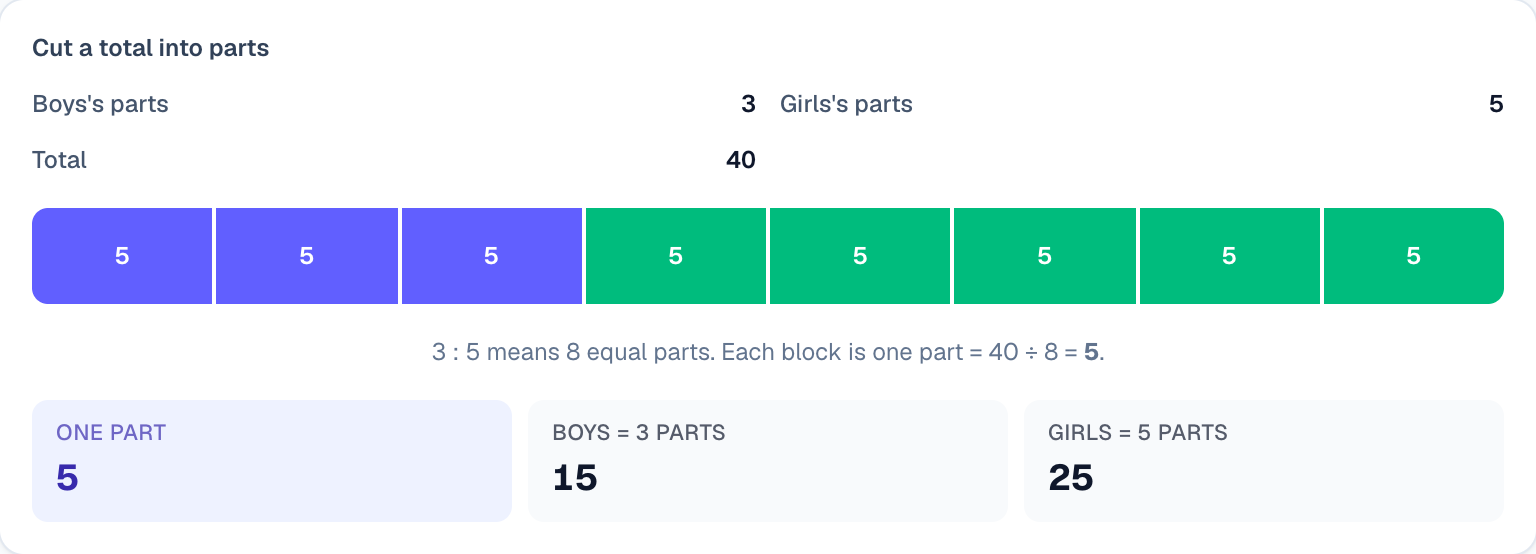
a : b  →  a + b equal parts
one part = total ÷ (a + b)
A's share = a/(a + b) of the total
Changing a ratio: adding to both terms
Shortcut: If the ratio is 3 : 5, write the numbers as 3k and 5k. One equation in k then settles every 'add x to both' or 'after t years' question.
Combining ratios: a : b and b : c
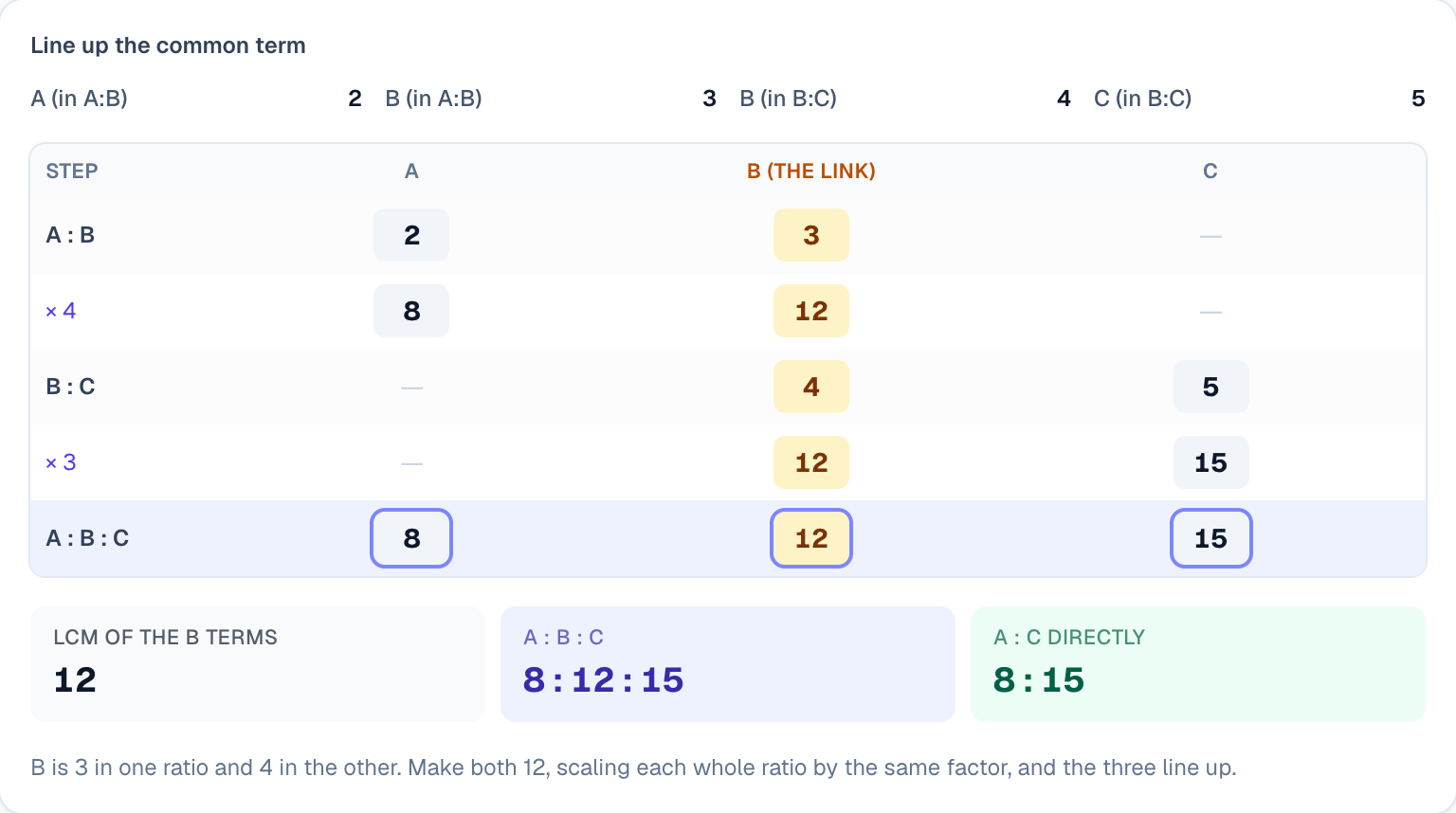
A : B = a : b,  B : C = c : d
A : B : C = ac : bc : bd
A : C = (a/b) × (c/d) = ac : bd
Shortcut: Need only A : C? Multiply the fractions: A/C = (A/B) × (B/C). For 2 : 3 and 4 : 5 that is 2/3 × 4/5 = 8/15.
Dividing a sum in a given ratio
Shortcut: Clear fractions with the LCM of the denominators: 1/2 : 1/3 : 1/4, times 12, is 6 : 4 : 3.
Proportion and componendo-dividendo
a : b = c : d  ⇔  ad = bc
mean proportional of a, b = √(ab)      e.g. 9, 16 → 12
third proportional to a, b = b²/a      e.g. 4, 6 → 9
fourth proportional to a, b, c = bc/a  e.g. 2, 3, 8 → 12
a/b = p/q  ⇔  (a + b)/(a − b) = (p + q)/(p − q)
| Rule | Result | Example from 2/3 = 4/6 |
|---|---|---|
| Invertendo | b/a = d/c | 3/2 = 6/4 |
| Alternendo | a/c = b/d | 2/4 = 3/6 |
| Componendo | (a + b)/b = (c + d)/d | 5/3 = 10/6 |
| Dividendo | (a − b)/b = (c − d)/d | −1/3 = −2/6 |
| Componendo-dividendo | (a + b)/(a − b) = (c + d)/(c − d) | 5/(−1) = 10/(−2) |
| Addendo | a/b = c/d = (a + c)/(b + d) = (pa + qc)/(pb + qd) | 2/3 = 6/9 = (2 + 4)/(3 + 6) |
Addendo works for any number of equal ratios: if a/b = c/d = e/f = k, then (a + c + e)/(b + d + f) = k too.
| Name | Ratio | From 4 : 9 |
|---|---|---|
| Inverse (reciprocal) | b : a (= 1/a : 1/b) | 9 : 4 |
| Duplicate | a² : b² | 16 : 81 |
| Sub-duplicate | √a : √b | 2 : 3 |
| Triplicate | a³ : b³ | 64 : 729 |
| Sub-triplicate | ∛a : ∛b | ∛4 : ∛9 |
| Compounded with c : d | ac : bd | with 3 : 2 → 12 : 18 = 2 : 3 |
Shortcut: Whenever you see (something + something)/(something − something) = a number, apply componendo-dividendo at once. It strips the expression down to a simple ratio.
Direct and inverse variation
y ∝ x    →  y = kx     →  y₁/x₁ = y₂/x₂
y ∝ 1/x  →  y = k/x    →  x₁y₁ = x₂y₂
y ∝ x²   →  y = kx²    →  x × 3 gives y × 9
Joint and part-fixed variation
y ∝ xz      →  y = kxz
y ∝ x/z     →  y = kx/z
part fixed  →  y = a + bx  (two data points give a and b)
Partnership: capital × time
share ∝ capital × months
same time for all  →  share ∝ capital
same capital       →  share ∝ months
Shortcut: When a partner changes capital midway, add the pieces: ₹20,000 for 6 months then ₹10,000 for 6 months = 1,20,000 + 60,000 = 1,80,000.
Formulas stick when you use them
The Ratio, Proportion and Variation lesson has worked problems and quick checks for every formula here. Free to start.
Start free