Arithmetic
Races and Clocks formulas
At a glance
beats by x m in L:  A : B = L : (L − x)     by x m or t s: B's speed = x/t
dead heat: start = margin     chains: multiply ratios
track: first meeting = L/(a − b) same way, L/(a + b) opposite
spots (p : q lowest terms): p − q same way, p + q opposite
all at start: LCM of lap times     all together: LCM of pair meeting times
clock angle = |30H − 5.5M|     M = (2/11)(30H ± θ)
12 h: 11 overlaps, 11 opposites, 22 right angles
gains g min/h: real = shown × 60/(60 + g)
What 'beats by' really says
L m race, A beats B by x m:  speed A : speed B = L : (L − x)
A beats B by t s:  B's time = A's time + t
A beats B by x m or t s:  B's speed = x / t
Head starts, dead heats and chains
dead heat: head start = margin in a level race
A gives B a start of h m (h < x):  A wins by x − h m
h > x:  B wins by (h − x) × L / (L − x) m
Shortcut: Chains multiply, they never add. A beats B by 10% of the distance and B beats C by 10%: C runs 0.9 × 0.9 = 0.81 of the race, so A beats C by 19%, not 20%.
Circular tracks: when and where they meet
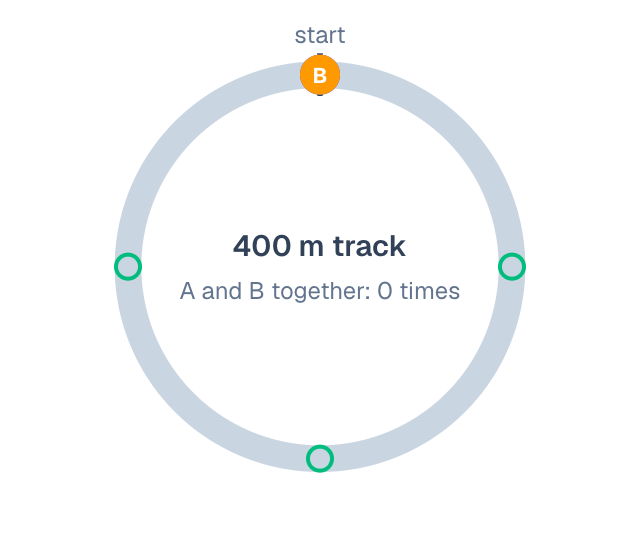
| Same direction | Opposite directions | |
|---|---|---|
| Relative speed | a − b | a + b |
| First meeting | L / (a − b) | L / (a + b) |
| Meetings in time T | ⌊T(a − b) / L⌋ | ⌊T(a + b) / L⌋ |
| Distinct meeting spots | p − q | p + q |
| Gap between spots | L / (p − q) | L / (p + q) |
The spots are evenly spaced, and one of them is always the start.
Back at the start, and three runners
all at the start: LCM of the lap times = L / HCF(a, b, c)
all together anywhere: LCM( L/|a − b|, L/|a − c| ) = L / HCF(|a − b|, |a − c|)
LCM of fractions = LCM of numerators / HCF of denominators
Clock hands are runners too
| Per minute | Per hour | One lap takes | |
|---|---|---|---|
| Minute hand | 6° | 360° | 60 min |
| Hour hand | 0.5° | 30° | 12 h |
| Minute hand's gain | 5.5° | 330° | 720/11 = 65 5/11 min |
angle at H:M = |30H − 5.5M|
if it is more than 180°, the smaller angle is 360° minus it
When the hands meet, oppose or square up
between H and H + 1:  M = (2/11)(30H ± θ)
coincide (θ = 0):  M = 60H / 11
opposite (θ = 180):  M = (2/11)(30H ± 180)
right angle (θ = 90):  M = (2/11)(30H ± 90)
| Position | In 12 hours | In 24 hours | The hour that misses out |
|---|---|---|---|
| Coincide (0°) | 11 | 22 | 11 to 12: it happens at 12:00 |
| Opposite (180°) | 11 | 22 | 5 to 6: it happens at 6:00 |
| Right angle (90°) | 22 | 44 | 2 to 3 and 8 to 9 have one each: 3:00 and 9:00 sit on the hour |
| Straight line (0° or 180°) | 22 | 44 | the two rows above together |
| Any other θ between 0° and 180° | 22 | 44 | two per lap gained |
Consecutive coincidences (or opposites) are 65 5/11 min apart; consecutive right angles are 180/5.5 = 32 8/11 min apart.
Shortcut: Coincidences are evenly spaced from 12:00: k × 65 5/11 minutes. So the third one after noon is at 3 × 65 5/11 = 196 4/11 min = 3:16 4/11.
Clocks that gain or lose
gains g min per hour:  real time passed = time shown × 60 / (60 + g)
loses g min per hour:  real time passed = time shown × 60 / (60 − g)
correct again after 720 / g real hours
Traps
| Trap | Tempting answer | What is actually true |
|---|---|---|
| Chained margins | 10 m + 10 m = 20 m | Ratios multiply: 0.9 × 0.9 → 19 m in 100 m |
| Start bigger than the margin | B wins by h − x | B wins by (h − x) × L/(L − x) |
| Beats by x m or t s | A's speed = x/t | B's speed = x/t |
| Meeting at the start | first meeting time | LCM of the lap times |
| Counting meeting spots | use 12 : 8 as is | reduce to 3 : 2 first |
| Overlaps in 12 hours | 12 | 11 (22 in a day) |
| Angle at 3:15 | 0° | 7.5°: the hour hand moves too |
| Fast clock, shown 8 h at +4 min/h | subtract 32 min | real time = shown × 60/64 |
Formulas stick when you use them
The Races and Clocks lesson has worked problems and quick checks for every formula here. Free to start.
Start free