Arithmetic
Mixtures and Alligation formulas
At a glance
mean = (c₁q₁ + c₂q₂) / (q₁ + q₂)
q₁ : q₂ = (c₂ − mean) : (mean − c₁)
water = 0% solution, pure substance = 100%
remove x of V, n times: V × (1 − x/V)ⁿ left;  different draws: multiply each (1 − xᵢ/V)
sold at CP: profit % = water / milk × 100
Mixing is weighted averaging
mixture = (c₁q₁ + c₂q₂) / (q₁ + q₂)
distance on each side ∝ 1 / quantity on that side
The alligation cross
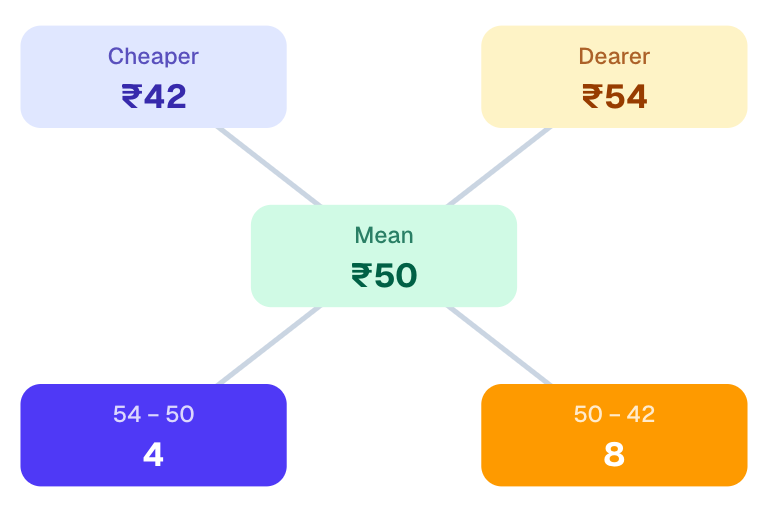
cheaper : dearer = (dearer − mean) : (mean − cheaper)
Adding water or the pure substance
Shortcut: Water is a 0% solution and the pure substance is 100%. So 'how much water to dilute 40% to 30%?' is an alligation of 40 and 0 around 30: solution : water = 30 : 10 = 3 : 1.
Remove and replace: successive dilution
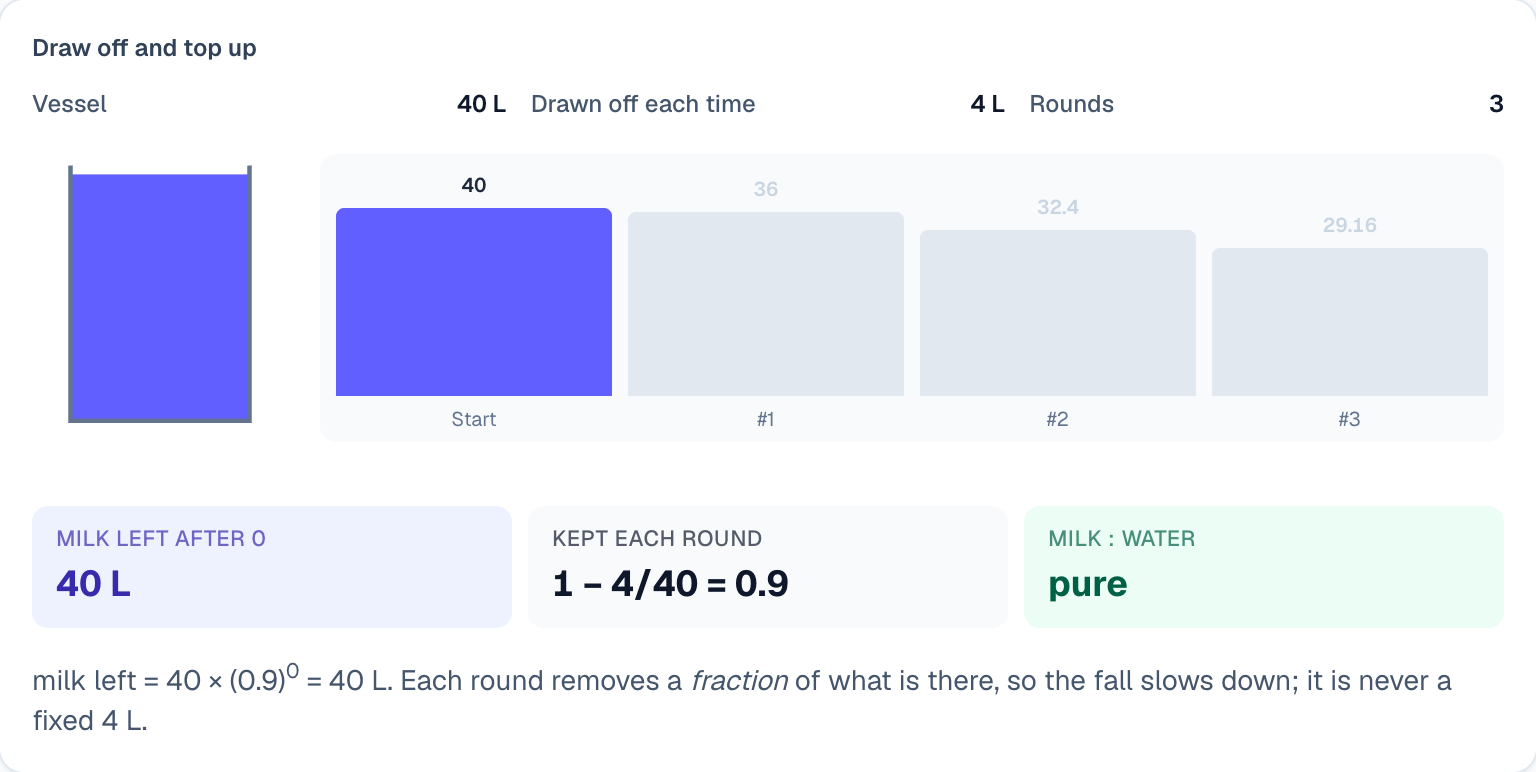
milk left = V × (1 − x/V)ⁿ
milk : water after n rounds = (1 − x/V)ⁿ : 1 − (1 − x/V)ⁿ
Shortcut: If the draws differ (x₁, then x₂, then x₃), multiply the separate keep-fractions: V × (1 − x₁/V)(1 − x₂/V)(1 − x₃/V). If the vessel starts as a c% solution and is topped up with water, the strength after n rounds is c × (1 − x/V)ⁿ %. 40% alcohol, a fifth replaced twice: 40 × 0.8 × 0.8 = 25.6%.
Mixing for profit
sold at cost price:  profit % = water / milk × 100
otherwise:  (milk + water)/milk × SP/CP = 1 + profit/100
Formulas stick when you use them
The Mixtures and Alligation lesson has worked problems and quick checks for every formula here. Free to start.
Start free